How V8 Supercharges WebAssembly with Speculative Inlining and Deoptimization
In the latest Chrome release (M137), the V8 JavaScript engine introduced two powerful optimizations for WebAssembly: speculative call_indirect inlining and deoptimization support. These techniques, long used for JavaScript, are now applied to WebAssembly to generate faster machine code by making educated guesses based on runtime feedback. This is especially beneficial for WasmGC, the garbage collection extension that enables managed languages like Dart, Java, and Kotlin to run efficiently. On Dart microbenchmarks, the combination yields over 50% speedup, while real-world applications see 1–8% gains. Below, we answer common questions about how these optimizations work and why they matter.
What are speculative optimizations and why are they now important for WebAssembly?
Speculative optimizations allow a compiler to generate efficient machine code by assuming certain behaviors based on past execution data. For example, if an operation a + b has always been integer addition, the compiler can emit specialized integer code rather than generic handling. If the assumption later fails, a deoptimization (deopt) rolls back to unoptimized code and collects fresh feedback. While JavaScript has relied on this for years, WebAssembly traditionally didn't need it because its static typing and ahead-of-time compilation (e.g., via Emscripten) already produced decent code. However, the arrival of WasmGC changed that. WasmGC introduces high-level types (structs, arrays, subtyping) and dynamic operations, making speculative optimization valuable for compiling managed languages. V8's new support for deopts and inlining in WebAssembly directly addresses this need, boosting performance in WasmGC programs.
How does speculative call_indirect inlining work in V8?
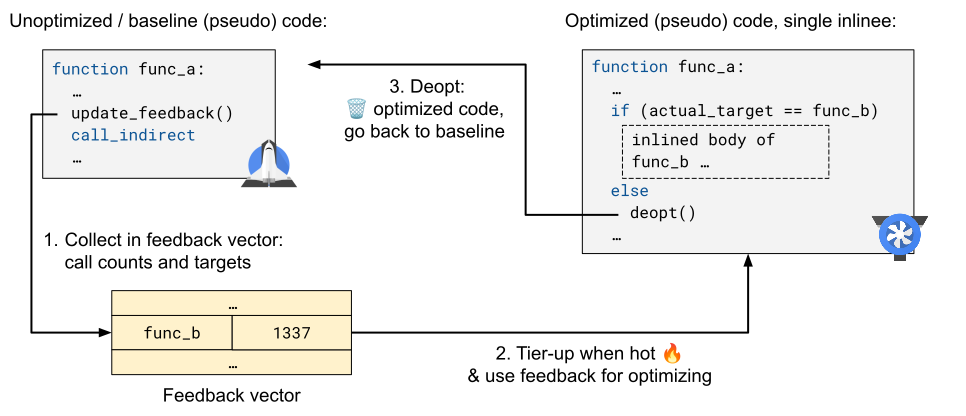
Call_indirect is a WebAssembly instruction used for dynamic function calls (like function pointers in C). Traditionally, V8 generated a generic dispatch for such calls – checking a type table and jumping to the correct function. With speculative inlining, the engine collects runtime feedback: if a particular call site repeatedly invokes the same function, V8 speculatively inlines (replaces the call with the function's body) that target. The compiler inserts a guard to verify the assumption at runtime. If the guard passes, the inlined code executes without dispatch overhead; if it fails, a deoptimization triggers, falling back to the generic path. This technique dramatically reduces call overhead, especially in WasmGC where polymorphic calls are common. Benchmarks show significant speedups in Dart and Java workloads, as the inlined code can also be further optimized within the calling context.
What role does deoptimization play in WebAssembly optimization?
Deoptimization (deopt) is the safety net that enables speculative optimizations. When V8 makes an assumption (e.g., about a function's type or target) and later that assumption proves false, the engine must gracefully exit the optimized code and resume correct execution. For WebAssembly, V8 implemented a full deoptimization mechanism that snapshots the WebAssembly state (locals, stack, etc.) and reconstructs it in a slower, unoptimized baseline. This is crucial because WasmGC programs may have changing behavior (e.g., different object layouts) that would otherwise cause crashes or wrong results. Deopts also allow the engine to collect new feedback and potentially re-optimize later with better assumptions. As a building block, deoptimization opens the door for many future optimizations, such as speculative type specialization and loop unrolling, which require a fallback path when guesses fail.
Why wasn't speculative optimization needed for WebAssembly before WasmGC?
Before the WasmGC extension, WebAssembly was largely a compilation target for C, C++, and Rust. These languages are statically typed and compiled ahead-of-time (AOT) with toolchains like LLVM or Binaryen, producing highly optimized binaries. The WebAssembly 1.0 instruction set is low-level (linear memory, fixed types), so V8's baseline and optimizing compilers could already generate efficient code without runtime feedback. Dynamic behaviors like function calls were either direct or via call_indirect with predictable targets. In contrast, JavaScript is highly dynamic, requiring speculative optimizations for performance. With WasmGC, WebAssembly gains high-level features (object-oriented dispatch, type hierarchies) similar to managed languages, making it more dynamic and thus benefiting from the same speculative techniques that power JavaScript JIT compilers.
How does WasmGC benefit from speculative optimizations compared to traditional WebAssembly?
WasmGC introduces rich types like structs, arrays, and interfaces with subtyping, along with operations such as struct.get, array.get, and polymorphic call_indirect. Traditional WebAssembly (1.0) lacks these – it only has flat types (i32, i64, f32, f64) and linear memory. Without speculation, V8 would generate generic code for every WasmGC operation, checking type tags and doing virtual dispatch at each call, incurring high overhead. Speculative optimizations allow V8 to inline property access and method calls based on observed concrete types, and to optimize type checks assuming the most common type. If the assumption fails, deoptimization handles the rare case. This is why Dart microbenchmarks (using WasmGC) see over 50% speedup: the engine can eliminate most dispatch overhead and generate tight, specialized code for the hot paths. Larger applications (e.g., Flutter UI) see 1–8% improvement, as they have more diverse behavior but still benefit from hotspot optimizations.
What performance improvements have been observed from these optimizations?
V8's internal benchmarks show dramatic gains. On a set of Dart microbenchmarks compiled to WasmGC, the combination of speculative inlining and deoptimization yields an average speedup of over 50%. For larger, realistic applications like Flutter and web-based games, the improvement ranges from 1% to 8%. These numbers come from Chrome M137, where the optimizations shipped. The difference between microbenchmarks and real apps is expected: microbenchmarks emphasize small, repeated operations (e.g., method calls) that benefit hugely from inlining, while real applications have I/O, rendering, and other factors. Nevertheless, even 1-8% is significant for user-perceived performance. The deoptimization infrastructure also enables future optimizations, such as speculative type specialization for array operations, which could bring further gains in WasmGC and beyond.
How do deopts and inlining work together in V8 for WebAssembly?
In V8's WebAssembly pipeline, speculative inlining is the primary user of deoptimization. When a call_indirect site collects feedback that a single function is always called, V8's Turbofan compiler generates a version that inlines that function's body. However, it also inserts a guard that checks the actual target against the assumed one. If the guard fails, a deoptimization bailout is triggered. At that point, V8 must reconstruct the WebAssembly call stack and local variables in a state compatible with the non-inlined baseline code. The deoptimization mechanism handles this by saving the current machine state and restoring it in the interpreter or Liftoff (baseline) tier. Then the engine can continue execution and collect more feedback for future re-optimization. This interplay allows V8 to take bold optimization steps safely, recovering quickly if the program's behavior changes – exactly the same pattern used for JavaScript TurboFan optimizations.